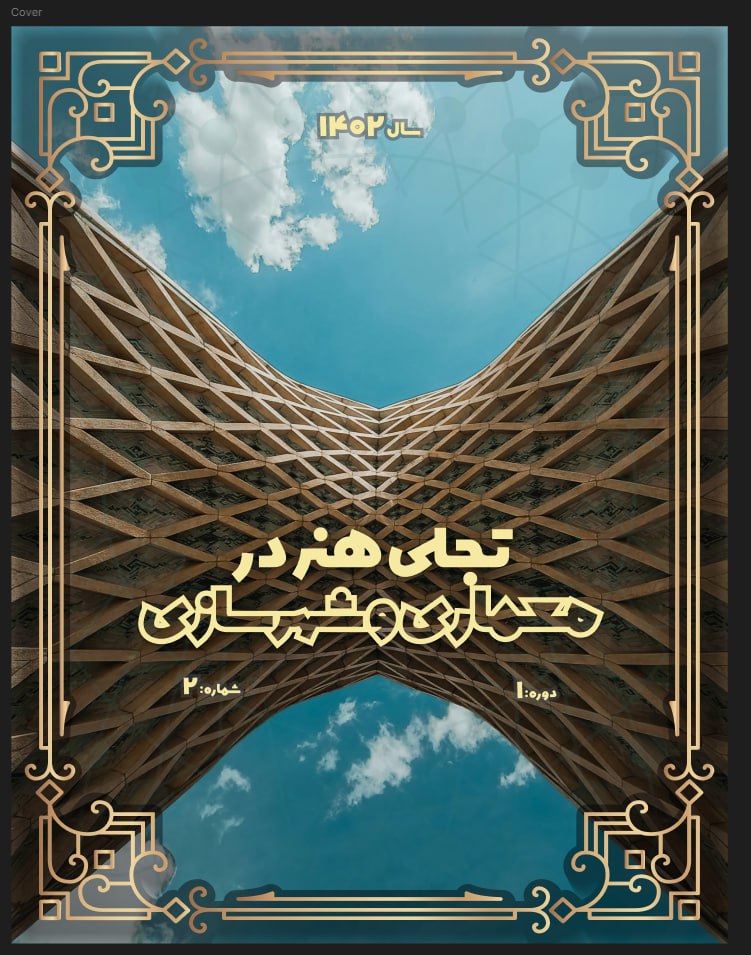
Sense, Form, Meaning: Redefining Tradition in Architectural Education Through Santayana’s Three-Level Model
Keywords:
Santayana, Traditional Iranian Architecture, Sensory Aesthetics, Symbolic Aesthetics, Architectural EducationAbstract
Contemporary architectural education in Iran faces a profound disconnection from its indigenous aesthetic tradition, a challenge rooted in the largely uncritical adoption of Western modernist models. Within this dualistic context, a fundamental question arises: Can traditional Iranian architecture, despite having developed without explicit knowledge of Western aesthetic philosophy, embody a rich and multidimensional aesthetic structure? Using a combined analytical–interpretive approach grounded in comparative case analysis, this study examines the hypothesis that traditional Iranian architecture implicitly operationalized the same three levels of aesthetics defined by George Santayana—sensory, formal, and symbolic—even before the emergence of this model in Western thought. Data were derived from two sources: (1) theoretical texts, including the works of Santayana, Kant, Pallasmaa, Böhme, Zumthor, and Iranian theorists; and (2) actual architectural cases, including the courtyard of Sheikh Lotfollah Mosque in Isfahan, the Soltaniyeh Dome in Zanjan, and Fin Garden in Kashan. Data were analyzed using a three-stage qualitative content analysis procedure comprising open, axial, and selective coding. The key findings indicate that: (1) in the Iranian courtyard, the sensory level is experienced through the warmth of stone, the sound of water, and diffused light; (2) the formal level is manifested in geometric proportions, axial symmetry, and spatial rhythm; and (3) the symbolic level is expressed through a sense of tranquility, place attachment, and connection with spirituality. Rather than operating independently, these three levels interact dynamically to create a “living” space—one that corresponds to what Santayana described as a “complete aesthetic experience.” The findings suggest that Santayana’s framework should not be regarded as a model to be imported into Iranian architectural education, but rather as an analytical lens through which implicit Iranian architectural knowledge can be articulated explicitly. This perspective offers an approach to “returning to tradition without imitation.”
Downloads
References
1. Hojjat M. Tradition in architecture: Both authentic and up-to-date. Abadi. 2007(54):128-33.
2. Namazifard H. Examining the transformations of contemporary Iranian architecture across different periods in terms of attention to past architecture. 2017.
3. Frampton K. Towards a Critical Regionalism: Six Points for an Architecture of Resistance. In: Foster H, editor. The Anti-Aesthetic: Bay Press; 1983. p. 16-30.
4. Kant I. Critique of Judgment. Pluhar WS, editor. United States: Hackett Publishing; 1987.
5. Saito Y. Aesthetics of Care: Practice in Everyday Life. London: Bloomsbury; 2022.
6. Leatherbarrow D. Architecture Oriented Otherwise. United States: Princeton Architectural Press; 2009.
7. Pallasmaa J. Encounters 2: Architectural Essays. Helsinki: Rakennustieto Publishing; 2013.
8. Böhme G. Atmospheric Architectures: The Aesthetics of Felt Spaces. London: Bloomsbury Academic; 2017.
9. Zumthor P. Thinking Architecture. 3rd expanded ed. Basel: Birkhäuser; 2010.
10. Hojjat M. Identity in architecture: An acquaintance for the bird of the celestial garden. Ayandeh-ye Khial. 2008(9).
11. Salahi E. Symbolic and formal aesthetics in architecture and its relationship with the human psyche. National Conference on Architecture, Culture, and Urban Management; Karaj2013.
12. Biglarian F. Examining the principle of symmetry in the facades of mosques in Iranian Islamic architecture: Case studies of Sheikh Lotfollah, Seyed, Hakim, Imam, and Jameh Mosques of Isfahan. National Conference on Iranian-Islamic Architecture and Urbanism; Rasht2015.
13. Saremi H, Anamnam M. Decoding geometry and proportions in Iranian architecture. National Conference on Architecture, Civil Engineering, and Modern Urban Development; Tabriz2014.
14. Akhavat H. Conceptual, functional, and aesthetic analysis of environmental elements of water and plants with emphasis on the physical aspect of Persian gardens. Environmental Science and Technology. 2014(4).
15. Mabhout M, Alizadeh Ghannad N. The concept of the dome as a symbol of unity and spirituality in Islamic architecture. International Conference on Architecture, Urbanism, Civil Engineering, Art and Environment: Future Horizons, Looking to the Past2015.
16. Pirnia MK. An Introduction to Islamic Architecture of Iran. Tehran: Cultural Heritage Organization Publications; 2000.
17. Wilber DN. The Architecture of Islamic Iran: The Il Khanid Period. United States: Princeton University Press; 1969.
18. Hosseini SM. Soltaniyeh Dome: A Masterpiece of Iranian Architecture. Zanjan: University of Zanjan Press; 2006.
19. Valizadeh N. Persian Gardens: From Pars to Qajar. Tehran: University of Tehran Press; 2011.
20. Strauss A, Corbin J. Basics of Qualitative Research: Techniques and Procedures for Developing Grounded Theory. Thousand Oaks, CA: Sage Publications; 1998.
21. Lawson B, Dorst K. Design Expertise. Abingdon: Routledge; 2015.
22. Lincoln YS, Guba EG. Naturalistic Inquiry. Beverly Hills, CA: Sage Publications; 1985.
23. Santayana G. The Sense of Beauty. United States: Scribner's Sons; 1896.
24. Hill J. Actions of Architecture: Architects and Creative Users. London: Routledge; 2003.
Downloads
Publication Timeline
- Submitted
- Revised
- Accepted
Issue
Section
License
Copyright (c) 2025 Marjan Tehranchipour (Author); Ali Asgharzadeh; Amir Hashempour Mafi (Author)

This work is licensed under a Creative Commons Attribution-NonCommercial 4.0 International License.