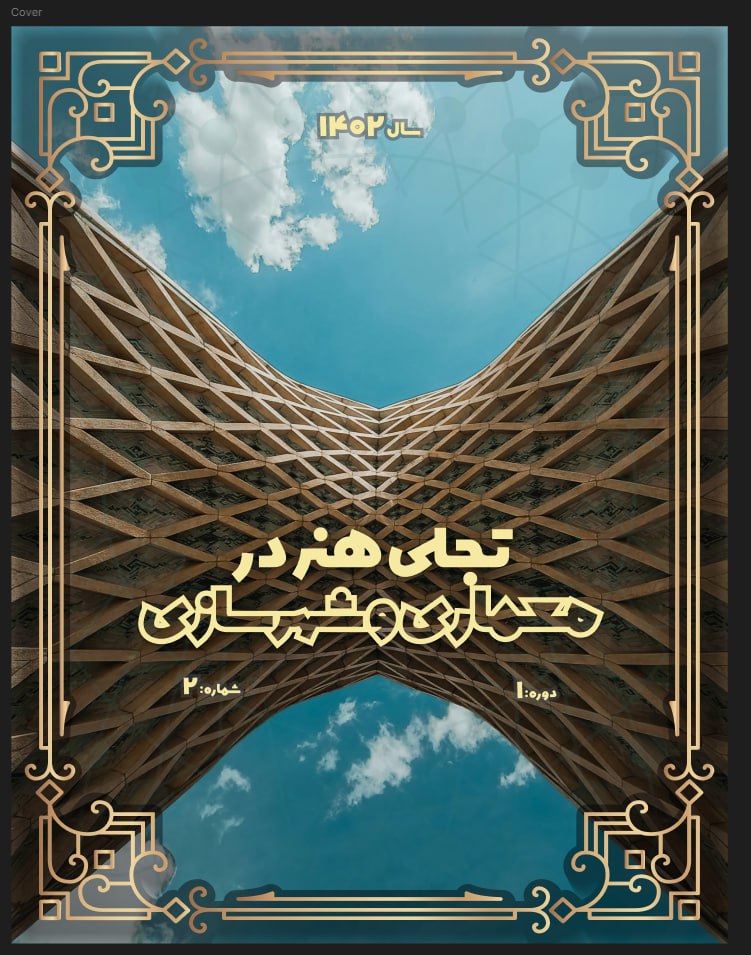
Reconsidering the Role of Urban Arsans in Enhancing Place Identity and Social Sustainability in Iranian Urban Spaces
Keywords:
Urban Arsan, Place Identity, Social Sustainability, -Public Space , Place Attachment, Urban RegenerationAbstract
This article aims to reconsider urban arsans as an indigenous model for enhancing place identity and social sustainability in contemporary Iranian urban spaces. In the tradition of the Iranian city, the arsan was not merely an arrangement of physical and functional elements; rather, it constituted a socio-spatial system in which spatial organization, collective activities, historical memory, and cultural meanings operated through a dynamic interrelationship. The present study adopts a review-analytical approach and employs a conceptual synthesis of the literature related to urban arsans, place identity, place attachment, public space, and social sustainability. The findings indicate that urban arsans contribute to the formation and consolidation of place identity by strengthening spatial legibility, historical continuity, semantic density, and the reproduction of collective memory. Moreover, characteristics such as social centrality, functional diversity, pedestrian orientation, human scale, opportunities for presence, and interaction capacity provide the conditions necessary for strengthening social cohesion and sustaining collective life within these spaces. Accordingly, the value of the arsan for the contemporary city lies not in the formal replication of historical patterns, but in the critical reinterpretation of its social, spatial, and cultural logic in accordance with present-day conditions. From this perspective, the urban arsan may be regarded as a theoretical and practical framework for rethinking the design and regeneration of public spaces, neighborhood centers, and contemporary communal hubs.
Downloads
References
1. Rahimi R, Shahamat H. Enhancing Social Sustainability in Public Spaces: An Evaluation of Garden Halls in Ilam, Iran. International Journal of Sustainable Building Technology and Urban Development. 2024;15(4):484-97.
2. Samavati S, Desmet PMA, Ranjbar E. Happy Urban Public Spaces: A Systematic Review of the Key Factors Affecting Citizen Happiness in Public Environments. Cities & Health. 2025;9(1):112-28.
3. Qi J, Mazumdar S, Vasconcelos AC. Understanding the Relationship Between Urban Public Space and Social Cohesion: A Systematic Review. International Journal of Community Well-Being. 2024;7:155-212.
4. Dianati V, Turcu C. Place (Un)making Through Soft Urban Densification: Exploring Local Experiences of Density and Place Attachment in Tehran. International Journal of Urban Sustainable Development. 2023;15(1):63-79.
5. Kamani Fard A, Paydar M. Place Attachment and Related Aspects in the Urban Setting. Urban Science. 2024;8(3):135.
6. Nemati Nasab MR, Sattari Sarbangholi H, Pakdelfard MR, Jamali S. Evaluating the Urban Cultural Spaces Based on Environmental Quality Components: Case Study of Tabriz City. International Journal of Nonlinear Analysis and Applications. 2024;15(9):151-64.
7. Mousavi SMR, Behzadpour M, Kalantari M, Khakzand M. Reading the Indicators Affecting Environmental Quality in Urban Arsens: A Comparative Study of Naqsh-e Jahan Arsen in Isfahan and Amir Chakhmaq Arsen in Yazd. Journal of Environmental Management (Amayesh-e Mohit). 2025;18(68):185-206.
8. Salama AM, Patil MP, Elsemellawy AN, Abudib HH, Almansor NA, MacLean L, et al. People-Place Narratives as Knowledge Typologies for Social Sustainability: Cases from Urban Contexts in the Global South. Buildings. 2024;14(4):1001.
9. Gupta A, Yadav M, Nayak BK. A Systematic Literature Review on Inclusive Public Open Spaces: Accessibility Standards and Universal Design Principles. Urban Science. 2025;9(6):181.
10. Li X, Kozlowski M, Salih SA, Ismail SB. Evaluating the Vitality of Urban Public Spaces: Perspectives on Crowd Activity and Built Environment. Archnet-IJAR: International Journal of Architectural Research. 2025;19(3):562-83.
11. United Nations Human Settlements Programme. Healthier Cities and Communities Through Public Spaces. United Nations Human Settlements Programme; 2025.
12. United Nations Human Settlements Programme. Global Public Space Programme: UN-Habitat's Initiatives Towards Safe, Inclusive and Accessible Green and Public Spaces for All. United Nations Human Settlements Programme; 2025.
13. John M, Turaev S, Al-Dabet S, Abdulghafor R. Multidimensional Assessment of Public Space Quality: A Comprehensive Framework Across Urban Space Typologies. arXiv; 2025.
14. Ramos-Vidal I, Dominguez de la Ossa E. A Systematic Review to Determine the Role of Public Space and Urban Design on Sense of Community. International Social Science Journal. 2024;74(252):633-55.
Downloads
Publication Timeline
- Submitted
- Revised
- Accepted
Issue
Section
License
Copyright (c) 2025 Shima Pedram (Author); Seyed Mahmood Moeini; Sara Jalalian (Author)

This work is licensed under a Creative Commons Attribution-NonCommercial 4.0 International License.