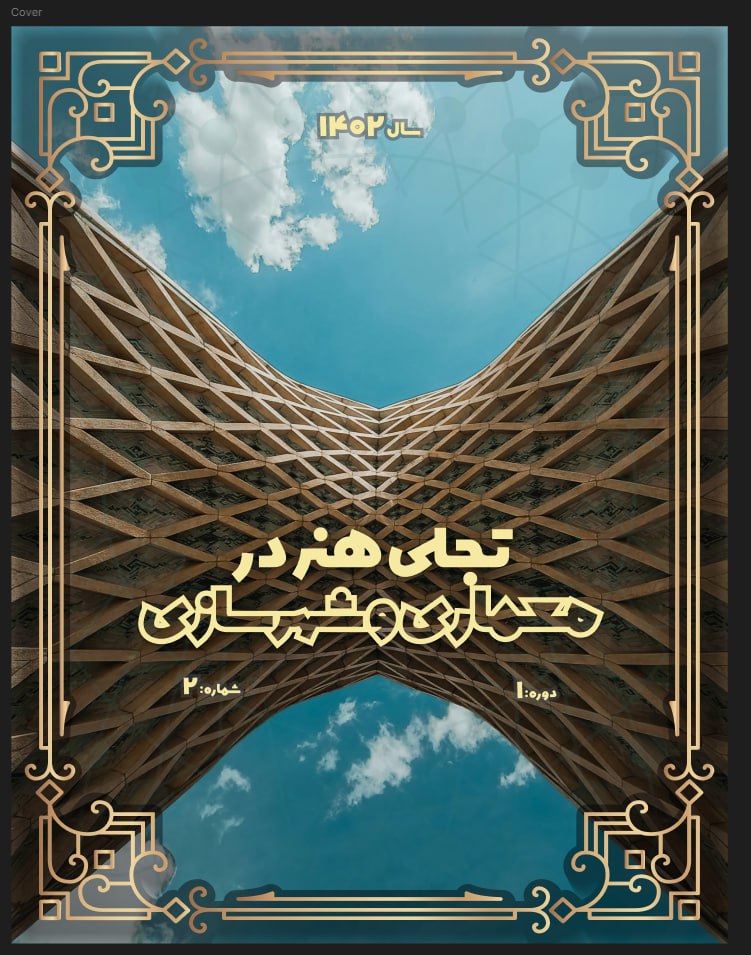
Regenerating the Sense of Place: A Dynamic Three-Layer Model for Contemporary Housing Reconstruction through a Re-reading of Qajar Houses in Kermanshah
Keywords:
Qajar houses of Kermanshah, architectural phenomenology, re-creation of spatial identity, lived experience, semantics of spaceAbstract
This study aims to develop a dynamic conceptual model for regenerating the sense of place in contemporary housing through an integrated reading of the physical, semantic, and experiential dimensions of Qajar houses in Kermanshah. Adopting a qualitative interpretive-phenomenological approach, the study employed a multiple case-study strategy. Six representative Qajar-era houses in the historic fabric of Kermanshah were purposefully selected. Data were collected through systematic field observation and architectural documentation, analysis of historical records, and semi-structured interviews with 25 participants, including 15 experts and 10 current or former residents. Data analysis was conducted using a three-stage interpretive thematic analysis comprising open coding, theme organization, and final synthesis. The analysis resulted in the formulation of a “dynamic three-layer model of form, meaning, and experience,” demonstrating that the sense of place emerges from a cyclical and non-linear interaction between spatial structure, cultural signification, and multisensory lived experience. The findings indicate that place identity can be effectively sustained only when cultural continuity, climatic responsiveness, and perceptual human-centeredness are simultaneously addressed, rather than through form-based imitation. The study concludes that regenerating identity in contemporary housing requires reactivating the meaning-making processes embedded in traditional architecture rather than replicating its formal elements, and that the proposed model offers a viable conceptual-operational framework for enhancing belonging and spatial quality in present-day residential design.
Downloads
References
1. Rapoport A. House form and culture: Prentice-Hall; 1969.
2. Relph E. Place and placelessness: Pion; 1976.
3. Habibi M. The Qajar house: Spatial culture and social transformation in 19th-century Iran: Edinburgh University Press; 2023.
4. Pirnia M. Stylistics of Iranian Architecture: Soroush Danesh Publications; 2008.
5. Zargar A. An Approach to Islamic Architecture of Iran: Shahid Beheshti University Publications; 2019.
6. Ahmadi Mousavi M, Naseri M. Typology of Historical Houses in Kashan. Journal of Iranian Architecture Studies. 2018;9(18):120-40.
7. Naghi-Zadeh M, Sharifi M. Introversion in Traditional Architecture of Tabriz. Bagh-e Nazar Journal. 2016;12(35):77-92.
8. Norberg-Schulz C. Genius loci: Towards a phenomenology of architecture: Rizzoli; 1980.
9. Merleau-Ponty M. Phenomenology of perception: Routledge & Kegan Paul; 1962.
10. Pallasmaa J. The eyes of the skin: Architecture and the senses: John Wiley & Sons; 2014.
11. Membrati A, De Luca F, Simeone D. Sensory phenomenology in vernacular architecture: A case study of Kurdish houses. Journal of Material Culture. 2023;28(1):45-67.
12. Kim J, Kim M. Integrating form, meaning, and experience in urban place-making: A theoretical framework. Journal of Urban Design. 2021;26(5):589-608.
13. Lotman YM. On the semiosphere. Sign Systems Studies. 2005;33(1):205-29.
14. Habibi M. Spatial Transformations of Residential Architecture in the Qajar Period: Case Study of Tehran: University of Tehran Publications; 2023.
15. Watenpaugh HZ. The image of an Ottoman city: Imperial architecture and urban experience in Aleppo in the 16th and 17th centuries: Brill; 2004.
16. Van Manen M. Phenomenology of practice: Meaning-giving methods in phenomenological research and writing: Routledge; 2014.
17. Braun V, Clarke V. Thematic analysis: A practical guide: Sage Publications; 2022.
18. Canizaro VB. Vernacular architecture and the cultural meaning of place: Routledge; 2022.
19. Foucault M. Of other spaces: Utopias and heterotopias. Architecture / Mouvement / Continuité. 1984(5):46-9.
20. Hillier B, Hanson J. The social logic of space: Cambridge University Press; 1984.
21. Soltanzadeh H. The Entrance in Iranian Architecture: Cultural Research Office; 2001.
22. Ahmed S. Queer phenomenology: Orientations, objects, others: Duke University Press; 2006.
Downloads
Publication Timeline
- Submitted
- Revised
- Accepted
Issue
Section
License
Copyright (c) 2025 Ehsan Daryoushi (Author); Arsalan Tahmasebi; Qader Bayzidi (Author)

This work is licensed under a Creative Commons Attribution-NonCommercial 4.0 International License.